Wednesday, November 22, 2017

Ideas!

I'm moving again, and I'm happy about it! I don't particularly want to take much time blogging now, because my limited time needs to be spent researching, but an update is in order.

In the past week, I've spoken with a professor from my undergrad, as well as with my boss at the Kean Writing Project, Kim Kiefer, who is a high school English teacher. Between those two conversations, I'm excited to write this thesis.

In my discussion with Kim, we talked about my interest in the YA hero, and discussed using The Hero With A Thousand Faces by Joseph Campbell, as one of my primary texts, as a way to analyze the hero's journey through the books I am interested in discussing (a list that I will explain later in this post). I have never read this book personally, although it has been discussed in many courses I have taken, and I am interested to see if it helps to guide my research. (note-- after writing this sentence, I remembered that Kean has a library and promptly walked over and checked it out)

Proof that I went to the library. Not pictured-- the spine falling off the book

In addition to this book, Kim also suggested that I read into Jungian archetypes as a way of discussing my heroes. I don't know much about Carl Jung outside of the Myers-Briggs personality test, so this is something I will have to research further. However, a baseline Google search brought this list to my attention. Of course, I will find a better primary source to use in my work.

Okay so, heroes and YA literature. That's still pretty broad. This is where my conversation with Dr. Hogsette (aforementioned undergrad prof) helped me further. 

In my senior year of college, I was in Dr. Hogsette's Science Fiction Literature class, and he talked a lot about the ideas of transhumanism and posthumanism in science fiction. Transhumanism and posthumanism are two tropes that are commonly used in utopian literature, as ways of proving that humanity can be so much more than it currently is, through the integration of technology. However, even though these ideas are usually presented positively, the stories ultimately warn that "all that glitters is not gold"-- or, perhaps, all that has circuits is not better than flesh and blood? Usually, these lessons come in the way of a utopian world turning into a dystopian nightmare.

I have to read more about trans and posthumanism to refresh my memory of their respective intricacies, but my professor gave me a ton of sources to look into including:
How We Became Posthuman: Virtual Bodies in Cybernetics, Literature, and Informatics by N. Katherine Hayles
Prophets of the Posthuman: American Fiction, Biotechnology, and the Ethics of Personhood by Christina Bieber Lake 
Our Posthuman Future: Consequences of the Biotechnology Revolution by Francis Fukuyama
Technology and Identity in Young Adult Fiction: The Posthuman Subject" by Victoria Flanagan

In considering all of the dystopian books I have read, there are a handful that I can think of that work with this idea. Right now, my list includes:
Uglies
Pretties
Specials
-by Scott Westerfeld
The Giver by Lois Lowry
Feed by M.T. Anderson
The Adoration of Jenna Fox by Mary E. Pearson
The City of Ember by Jeanne Duprau
Life As We Knew It by Susan Beth Pfeffer (this one is still on the "to-read" list, but I'm reasonably sure it will fit the topic)

In all of these books, the characters, or their world has been altered for some specific technological end, and the protagonists have to deal with the implications of these changes. Ultimately, what the world-builders hoped would lead to utopia, has instead led to dystopia, and we are left with the question of-- why are we searching to perfect mankind through technology? Are we ultimately better for it? Have we reached the ultimate moral nirvana? Signs point to no.

Finally-- why the YA lit focus? Simply, because I like it. Maybe I'll discover some kind of theory as to why kids are into these books...and maybe not. We'll see where the research takes me. 

Wednesday, November 15, 2017

I'm still here.

How do you write a thesis with no idea of what you want to write about? I'm floundering and I don't see any end to this struggle. If I graduate this program, it might be a miracle.

I'm scrapping all the work I have done up to this point because I'm no longer inspired. The only thing left that I care about is the literature, and I don't know what to do with that. I'm trolled the internet looking for ideas, Young Adult reading lists, trends in topic popularity, what kids look for in literature-- I've found interesting ideas, but nothing from which I can build a thesis.

Today I went back to the literature review that I wrote back in Writing Research, during my first semester at Kean. When I wrote that, I was still passionate about my topic, and I think I'm going to revisit my original ideas. I'll link my lit review here for the sake of context, but I think this is where I need to start again-- just me, the texts I love, and article talking about those texts. I do have ideas that I've explored further that I can rework into this format, but I hope this is where I start to find answers. If not here...where?

https://docs.google.com/document/d/1mBzgYppTjsXlr2RkAKP9wewrtuwqTrmVvAS3hTyRSPA/edit?usp=sharing

Thursday, November 2, 2017

More Sources!

I forgot to add-- here are the additional sources I have discovered in my reading today:

"Network Analysis and the Sociology of Modernism" by Richard Jean So and Hoyt Long

"The Werther Effect I: Goethe, Objecthood, and the Handling of Knowledge" by Adrew Piper and Mark Algee-Hewitt

"Web Writing: Why and How for Liberal Arts Teaching and Learning" by Jack Dougherty and Tennyson O'Donnell

Hacking the Academy: New Approaches to Scholarship and Teaching from Digital Humanities  by Daniel J. Cohen and Tom Scheinfeldt

The Socially Networked Classroom: Teaching in the New Media Age by William Kist

Handbook of Research on New Literacies by Donald J. Leu Jr., Julie Coiro, Michele Knobel, and Colin Lankshear

Literacy Remix: Bridging Adolescents In and Out of School Literacies by Jessie Gainer and Diane Lapp

Blogs, Wikipedia, Second Life, and Beyond: From Production to Produsage by Axel Bruns

"New Learning Environments for the 21st Century" by John Seely Brown

Reconceptualizing the Literacies in Adolescents' Lives: Bridging the Everyday/Academic Divide by Donna E. Alvermann and Kathleen A. Hinchman

~~~

It is a good thing I am a graduate student, I suppose, the work keeps me busy on my frequent 3 hour train rides down to visit my fiance and friends in Washington, D.C. I will hardly know what to do on the train once I graduate and don't have tons of reading!


Tallies and work

Forgive the format of these blog posts, but I've found that stream-of-conscious writing works best for me to detail my thesis work. To begin for today:

I often joke that in the past few months I've developed running tallies for things that I've considered innumerable times. To date, the list includes:
-Rewrites to my thesis
-Times I've asked myself, "Is a Masters degree really worth it?"
-Throwing my computer out the window and quitting my job
-Eloping rather than dealing with the intricacies of planning a wedding

and, my latest addition:
-How many Starbucks iced coffees have I bought so far this semester?

That new addition to the list scares me the most. 

~~~

As for my thesis work, last night I started reading through some of the sources I've compiled thus far, and I found myself feeling disheartened. A few that I thought would be spot-on proved to be disappointing, and I'm hoping that I have more luck today. What worries me more than anything is that I'm going to spend a lot of time doing research, only to prove to myself that my thesis isn't valid. Sometimes I wonder why I let myself wander so far from my literary roots.

Other times, however, I am heartened by my ability to tie the literature I am passionate about to methodologies that may help teachers, and I do genuinely believe in the validity of my work. I'm excited by the potential to go to OER18 and possibly present my work, and in those moments I find the strength to move on.

~~~

Update!
I have my research split into three piles-- "Education," "Digital Humanities," and "Literature." I've been sorting my sources into these three piles as best I can, to pretend I have some semblance of order, even though some of my research crosses boundaries. First, I read through my "Education" binder and found one dud article, one kinda-outdated-but-maybe(?)-helpful article, and one great article. I used the Works Cited article to find about more sources I may be able to use. I'll look them up on my train ride tomorrow. 

The education sources have been great ways to learn about how teachers have worked in introduce technology to their classrooms, although in reading through these sources I find more mention to tools, rather than blatant mention of the digital humanities-- which makes sense, coming from an education standpoint. For this reason, I'm glad for my wealth of DH sources.

I found similar success with my DH sources, in reading through the articles I found more sources to check out and, even better, I found examples of DH projects which, in my opinion, will be powerful arguments for the cross-disciplinary nature of DH.

The thought occurred to me that I might use more advanced DH work as a way to either start or end my thesis, to show readers why digital tools are important. On the one hand, using Hypothes.is and Voyant is much different than using a text analysis program, but on the other hand, you have to start somewhere. By making students aware of what can be done with digital tools, you are showing them potential doors they might consider going through in the future.  

Wednesday, November 1, 2017

Uninteresting Updates

Reading, reading, reading, reading, reading! That's what I'm up to!

Today I braved the Kean computer lab for the second time in my graduate career and printed out my list of sources from last week. It was a fairly uneventful experience, and I'm excited to see the resources I have so far.

In talking to Alan, he made me think harder on how I'm going to include my love of dystopian lit into the piece, and I'm hopeful that it will still shine through strong, despite my focus on DH tools and analysis. In order to draw a strong parallel between my work and dystopian lit, I'm going to have to delve into research explaining the themes of dystopian lit-- such as control, fear, and pushing forward into the future, and include that as a substantial part of the start of my paper, which is just fine with me!

I'll blog more tomorrow about what I find in my reading, and, speaking of which, back to that!

Thursday, October 26, 2017

Sources thus far

Books:

Reading in Participatory Culture: Remixing Moby-Dick in the English Classroom by Henry Jenkins

Distant Reading by Franco Moretti

Digital Humanities and the Lost Drama of Early Modern England: Ten Case Studies by Matthew Steggle

Literature-Based Sources:

"Tragedy, for Example: Distant Reading and Exemplary Reading (Moretti)" by Paul Fleming

"Where the Machine Stops: Software as Reader and the Rise of New Literatures" by Tom Liam Lynch

"Digital Humanities and It's Application in the Study of Literature and Culture" by Matthew Wilkens


"Method as tautology in the digital humanities" by David-Antoine Williams

"Soft(a)ware in the English Classroom" by Tom Liam Lynch

"Open Annotation and Close Reading the Victorian Text: Using Hypothes.is with Students" Meegan Kennedy

Education-Based Sources:

"Literacy Learning in a Digitally Rich Humanities Classroom" by Mary Frances Buckley-Marudas

"Finding and Contextualizing Resources: A Digital Literacy Tool's Impact in Ninth-Grade World History" by Adam M. Friedman and Tina L. Heafner

"The Council of Youth Research: Critical Literacy and Civic Agency in the Digital Age" by Antero Garcia, Nicole Mirra, Ernest Morrell, Antonio Martinez and D'Artagnam Scorza

"Exploring the 'digital disconnect' between net-savvy students and their schools" by Neil Selwyn


Wednesday, October 25, 2017

Spiraling with focus

I keep a sticky note open on my desktop at all times, with a running tally of how many times I've reworked (totally or partially) my thesis idea. Currently, the count is at 6, and we're only two months into the adventure.

However, I do feel that I am getting closer to home. In receiving excellent advice from various sources, among whom I can list Kim Jaxon, Barbara Ganley, and Alan, I've come to the conclusion that, while tools are great, what I need to focus on is methodology. I'm going to look at the different DH methologies that I think might be helpful to teachers, and unpack them as simply and clearly as possible. The most important thing I can do at this point is show people what the field has to offer, rather than exclusively focusing on tools that may not be relevant in a very short time.

That's not to say that tools are out completely, I'm still going to introduce them as examples under their respective methodology. Through the tools, I shall incorporate my dystopian literary example (example? right now I'm unsure of if I will be focusing on one text, or a small handful) as a way of showing how DH can be applied to a text. In doing this, I will use the tools as examples of what technology currently has to offer, while also keeping methodologies the primary focus of the paper. I want to show teachers what is possible, while incorporating the truth that technology is an ever-changing organism, and the tools we use today will likely be outdated tomorrow.

--

After last week's "Thesis Tank," I started to think about the options that I have in front of my for my thesis-- namely, why am I writing it? It's been fantastic to hear the opinions and experience of different people throughout these Hangout encounters and, although so many ideas can be overwhelming, it has helped me to think about what I want at the end of this endeavor.

First, and foremost, I want a paper that I can submit to education magazines or journals, as something understandable and accessible to the average person. I'm not about gatekeeping or ivory towers, and I want the language and subject matter of my thesis to communicate that. I'm not in this for academia, I'm in this for students.

Second, I need to speak with teachers. I want to find out what has changed in the classroom since I graduated high school in 2011-- back then, we had computer carts and PowerPoint presentations. I need to know what teachers are using to reach their students. I don't believe I will be pursuing IRB approval for my work, because I don't feel that it is applicable to my study. If I were already a teacher, I might consider a more targeted project and test it on my students but, as that is not the case, I am going to work with the tools (and connections) I already have on hand.

Third, I'm going to use the library databases to see if I can find articles about DH in cross-curricular fields-- which will cater to my interest in reaching students in departments other than English. I believe that this field has an interesting opportunity to unify departments, and I believe that is an idea worth pursuing.

--

More tomorrow but, for now:


Wednesday, October 18, 2017

Bringing the DH to the next generation

My thesis work is based on my observation of the need for digital humanities education in younger grades. Digital humanities, which can broadly be explained as “the application of computational tools and methods to traditional liberal arts disciplines,” is an observably large umbrella, under which are grouped tools and methodologies which can be applied to different fields in different ways.

Although the Digital Age is dated within the last few decades, it wasn’t until the early 2000s that the average American home housed a desktop computer. Therefore, computers are still a relatively modern technology, particularly in schools. As recently as 2007, it was not required that a high school student have access to a laptop computer during the school day, and PC computer labs were still widely in use. More recently, however, school districts have switched to providing laptops to students, and more typing is done than writing on a daily basis.

All this considered, literary endeavors remain rooted in traditional close reading methodologies and digital technology is merely used for presentations and traditional research, with the rest of its powers delegated to STEM classrooms.

Average English majors stay within the four walls of the English department for the extent of their undergraduate career, where they are exposed to traditional literary criticism and creative writing outlets. Many continue through grad school without ever hearing of the digital humanities. Although interest in the field is growing fast, scholars and DH departments are scattered throughout the country, and across disciplines and, in order for a DH program to grow, cross-disciplinary collaboration is crucial. There is no simpler rationalization for this that the fact than most literary scholars are naturally not well versed in the technological intricacies that could aid their own work.

Although, as noted, the digital humanities can be a daunting field, this does not need to be the case. My mission for this paper is to unpack methodologies and tools within the field, in order to make it accessible to a person with average computer skills, while addressing the following problems.

First of all, I seek to discredit the traditional fear within the literary community that technology stands in opposition to the humanities. Technology, like our eyes’ ability to read, is just another tool in the arsenal of scholarship, and the digital humanities offer methodologies as helpful as the methodologies that are tried-and-true. If it is possible for a computer program to analyze information and deliver a report of word frequencies, or map the use of a phrase throughout an entire corpus, shouldn’t it be available to an inquiring student?

Second, I believe that, in order to build a field, it’s important to start from the ground up. When the digital humanities field is relegated to graduate work, it’s not accessible to students who might be interested from a younger age. For that reason, I seek to educate high school teachers in the use of methodologies and tools that are easily grasped, and therefore easily taught. Methodology categories will be focused on first- visualizations, mapping, distant reading and text analysis- and then broken down into programs that might be useful to the average teacher- such as Ngram, Voyant, and Hypothes.is.

Third, I believe this is important because it has the opportunity to serve cross-disciplinary purposes. People interested in the digital humanities span the academic spectrum, from computer scientists with an interest in coding, to historians, to literary theorists. If such a field is accessible from a young age, it may be possible to bridge the gaping divides between departments, and inspire students with cross-curricular talents.

I plan to tackle this project through the lens of dystopian literature, a genre I have chosen for a few reasons. In addition to being my personal favorite genre, books such as 1984, Fahrenheit 451 and Brave New World are often on school required reading lists, however they aren't as commonly required as Shakespeare or Jane Austen. In choosing these books, I choose stories that are familiar, although not overdone. In regard to theme, dystopian fiction is usually born from the fear of uprising, or technological or governmental control-- which I think it’s an interesting frame for a project that is often rooted in technological suspicion.

Ultimately, I believe there is validity in introducing technology to a younger generation in a way that is accessible and interesting, so that we may encourage future scholars to collaborate across departments and use available tools to their fullest potential.

Thursday, October 12, 2017

Meet the Librarians

Librarians are significantly less harmful than Welcome to Night Vale would have one believe. However, I'm not taking any chances...


I didn't know what to expect from my meeting with one of the Kean librarians, so I went in hopeful that anything I might learn could be helpful. I have friends studying to be research librarians, so I am aware that a good librarian is a handy research partner. Was this the case at Kean? I have to admit that the lady I spoke with, Linda, was fairly helpful.

One of my questions for Linda was regarding copyright law in relation to the use of e-books, and she went above and beyond to give me an impressive amount of information regarding copyright policies. She admitted that she wasn't well versed in the matter, but she compiled an impressive amount of information on the topic. I also asked Linda to help me find sites upon which I could access free e-books, and she gave me a list of four different sites to explore, each of which linked out to several more sites worth of resources.

After we spoke about my questions, she showed me how to use the library website to access resources available both through the Kean library and through inter-library loan sources.

I have to admit that I learned more than I expected to from the experience. In all honesty, I think that I could have done the same research and found similar resources, but it was really nice to get help from someone whose job is to do research and help students. I think that there are some thesis-specific things that I would need to research myself, considering that I am entrenched in the field and have a better understanding, but this meeting was good for getting help with a more general topic. 

All things considered, not bad. As I am fond of saying, menzamenz


Wednesday, October 4, 2017

An Adventure in Google Ngram

In these next few weeks, my plan is to use my blog posts to explore programs that I am considering using in my thesis work and, since I'm already familiar with Voyant and Hypothes.is, I'm going to start this week by researching Google Ngram.

In one conversation between Alan and myself, the topic of accessibility came up, and we tossed around the issue of how to determine if a tool is reasonably easy to learn. Between myself and my target group, few DH newcomers are going to have the time or expertise to learn the more complicated programs. As I discover tools that I'm interested in using, I'm going to have to come with with an accessibility scale, in order to determine the level of difficulty at which to rank each individual tool. I'm not entirely sure how I'm going to do this yet, but right now my standard is simple-- can Google teach me?

Not knowing much about Ngram, I decided to do as all good students do, and immediately check Wikipedia (I'm getting my Masters degree and it hasn't failed me yet, alright?). Here's how Wikipedia describes the tool:
An online search engine that charts frequencies of any set of comma-delimited search strings using a yearly count of n-grams found in sources printed between 1500 and 2008 in Google's text corpora in English, Chinese (simplified), French, German, Hebrew, Italian, Russian, or Spanish; there are also some specialized English corpora, such as American English, British English, English Fiction, and English One Million; the 2009 version of most corpora is also available.
The program can search for a single word or a phrase, including misspellings or gibberish. The n-grams are matched with the text within the selected corpus, optionally using case-sensitive spelling (which compares the exact use of uppercase letters), and, if found in 40 or more books, are then plotted on a graph.
This seems to be quite a powerful tool! What interested me most in this blurb is that the search engine has been programmed to work with such an amazingly large corpus. Although much modern work is still within copyright, it's amazing to be that one program can harness books written over the course of 500 years-- that's astronomical! From this alone, it seems that Ngram will be quite useful to my work.

My next step was to Google "Google Ngram tutorial" and see what I could learn. The first result seemed helpful, so I clicked and this is what I found.

Following the instructions on the webpage, I went to Ngram viewer, typed in a few phrases, and chose a time frame. Because I'm sticking with my dystopian literature theme, I tried to use phrases that I thought would lead to helpful results, and made my time frame span from 1850 to 2000.

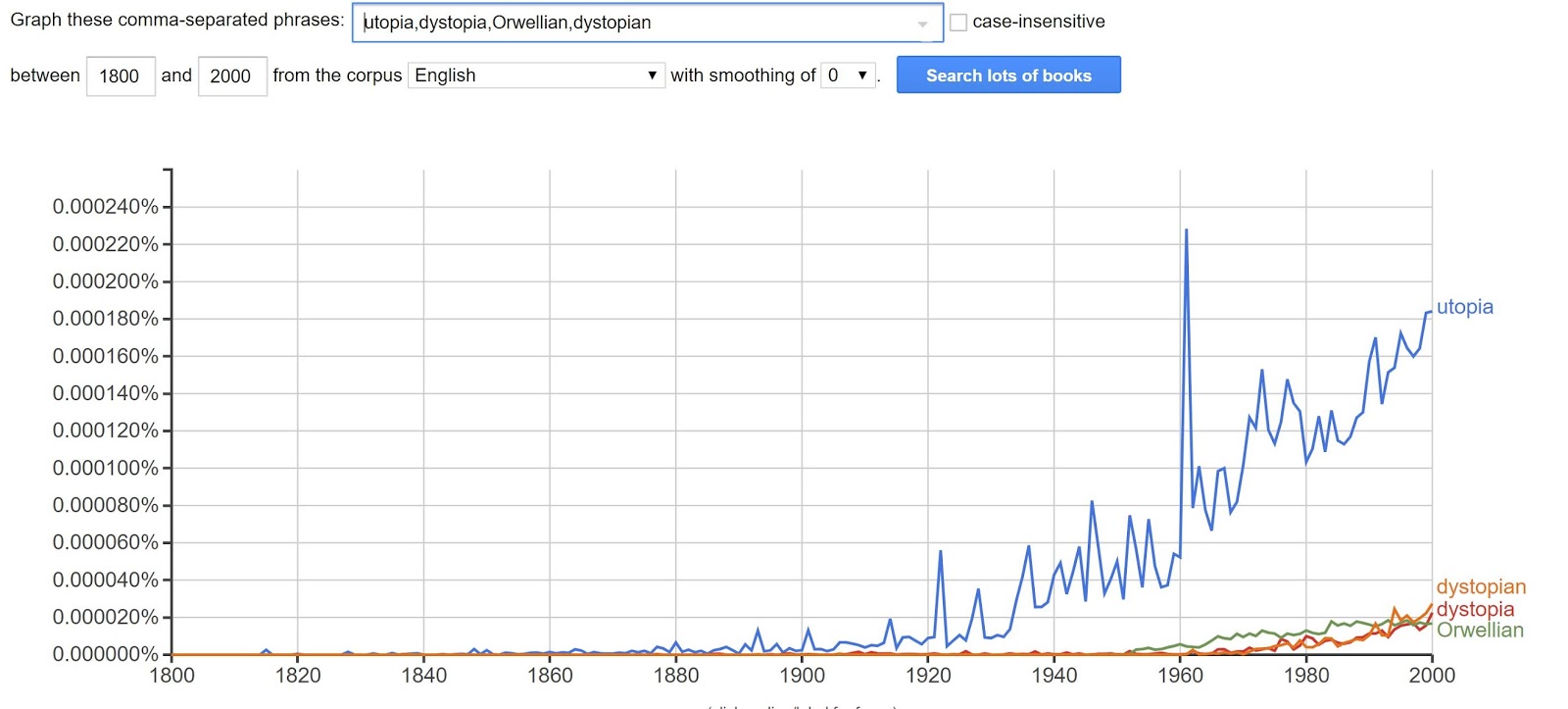
The following screen grab shows my results from messing around a bit with the program. It's quite interesting, although I'm surprised that my keywords aren't more successful-- although maybe I'm just not understanding the results. I'm going to tweet out the link to my blog and see if anyone with more knowledge of Ngram responds.

Here are the results from my first searches:


Just from these results, it's interesting to me that the phrase "utopia" spiked in the 1960s, and this is the kind of thing that would lead research questions. In the case of a high school student, this could be a spark that would lead to research for a paper topic. Already, there are good, useful reasons for a teacher to delve into this program.

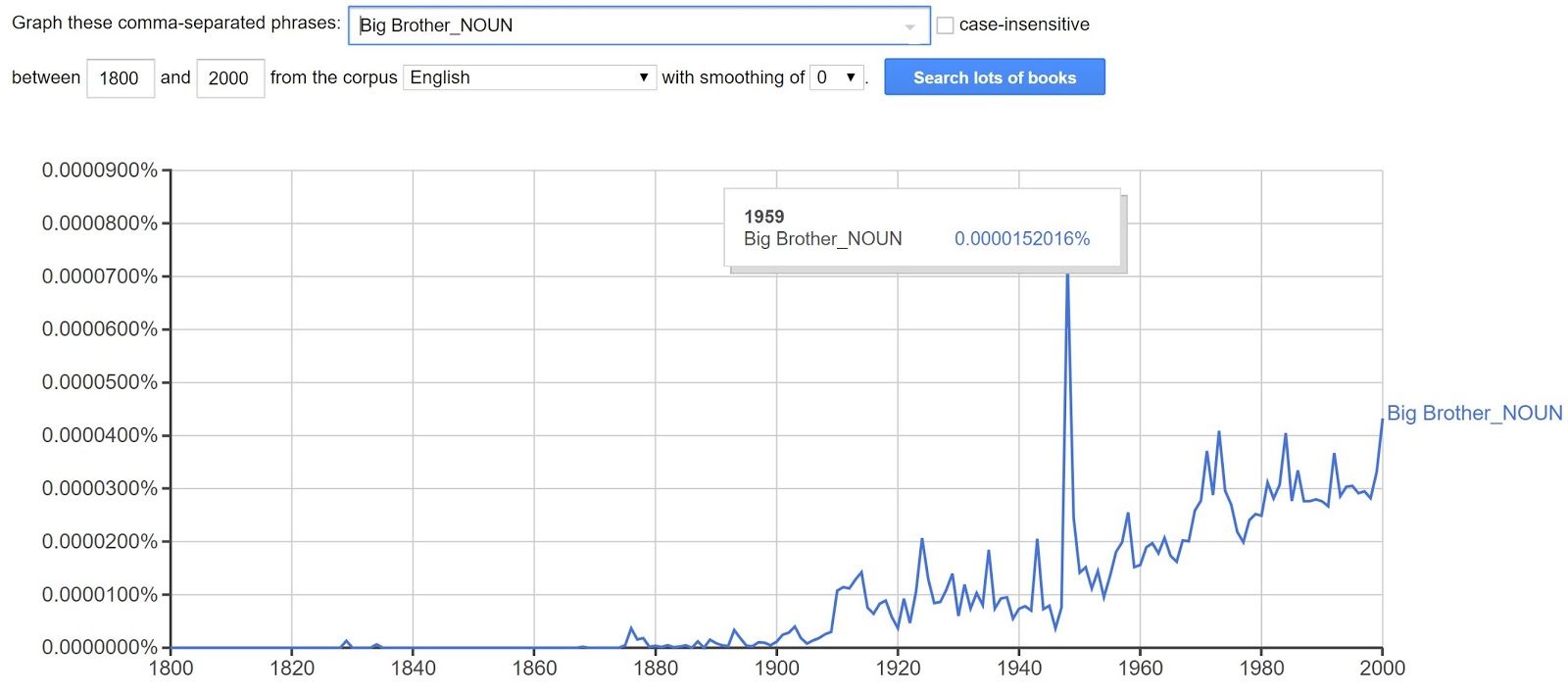
Lifewire (see above link) also had helpful information for drilling down into more specific tag related searches, which I tried with the search term "Big Brother_NOUN" -- as to differentiate Orwell's all-seeing government from books about familial relations.


How cool is this?? 1984 was published in 1949 and, low and behold, the term spiked around that time period, before dropping off and slowly climbing again. So interesting!

I decided to play around a bit more, and in doing so I found another cool use of the tags feature. I searched "Orwellian" earlier and was less than impressed with the search results. However, this time around I searched "Orwellian_NOUN" and found much more to talk about. Quite interesting how the term has spiked in use in the past 30+ years...


In my browsing, I also found that Google's Ngram help page was useful in picking up some more tips and tricks about the program, such as the following search enhancers:

So much to learn! So much power to harness!
From Google's help page, I learned about the => modifier tag, which tracks term dependencies. For example, on the page the writer explains how the word "tasty" often modifies the word "dessert," there one might search tasty=>dessert. For my purposes I searched utopian=>society:


Strangely, I couldn't find significant results for "dystopian=>society" but the search continues!

Luckily, I had success in my search for "dystopia" as the root of the sentence in this next example, in which I obtained results via the comment _ROOT_=>dystopia. As you can see: in 1994-1995, the topic of dystopia spiked:


Another command recommended by the Ngram info page was [entry]=>*_NOUN, which takes the entry you put in, and uses the * in order to fill in the top ten noun substitutions for the search. For example, I searched utopia=>*_NOUN and my results showed:


As you can see in this graph, the top ranking results is "utopia=>Morris", which spiked in 1977. Who's Morris? I have no idea, but this is the reason that this program is great for research!

Here are some more results for dystopia=>*_NOUN, with the graph settings adjusted slightly:


If you can't tell, I am extremely excited by this adventure into Ngram and am quite hopeful that this will be excellent for my thesis work!

---
*Semi-unrelated aside:

Although my thesis work is based in literature, I was interested in the implications of using Ngram to track the intricacies of language. The very first sentence of the Lifewire link reads:
"A Ngram, also commonly called an N-gram is a statistical analysis of text or speech content to find n (a number) of some sort of item in the text. It could be all sorts of things, like phonemes, prefixes, phrases, or letters."
"Phonemes, prefixes" caught my interest immediately. Outside of literature, I am incredible interested in phonetics and the sounds and pronunciations that make up English, among other languages. Ngram may prove to be useful to me in other areas in my life, it would be cool to see how it could be used to trace language throughout the years. The above-mentioned Google link also had a great deal of information regarding how the program might be used to track language trends. Excuse the aside, but that's what I love about research and learning, you're never done falling down new rabbit holes!

Question for the Kean Librarians

If you aren't familiar with the podcast, Welcome to Nightvale, than the assignment to go speak to the research librarians at Kean's library is a perfectly innocuous assignment that will either end with helpful information or, at the very worst, an hour of lost time.

If you are familiar with Welcome to Nightvale, you should understand the following image.


And, if you're not familiar with Welcome to Night Vale, here's your homework: Episode 1.

Anyway, I've made my appointment to meet with Kean research librarian Linda Cifelli on Thursday, October 12th at 2:45 p.m. I've thought about what I want to ask her, and I emailed her the following question:
I would like to learn more about finding public domain books online and/or about the copyright laws surrounding the usage of copyrighted texts for research purposes. My thesis is centered around using computer programs/tools in order to analyze literature, so you can see why it's important for me to understand fair use, and to know where to find public domain texts.
I'm interested to see what she can show me, and I'm hopeful that the Kean library will prove to be a valuable resource!


I Want Sin: Finding Personhood Amidst Technology in Young Adult Dystopian Literature

I am excited to announce that my thesis, "I Want Sin: Finding Personhood Amidst Technology in Young Adult Dystopian Literature," h...